
Before I even begin, I want to make sure and clarify here that by no means is this post looking to mock or ridicule EDHRec by any measure. EDHRec is a recommendation site that provides data and assistance to gamers looking to build and upgrade their decks.
I’ve been seeing a lot of noise and traction coming from Y’shtola’s rise to the number one spot on EDHRec. As a result, I’ve decided to throw in my own opinion about what’s happening there, what this means for EDH at large, and how I feel about the top commanders overall.

From an initial view point, there’s quite a few things to share and talk about here. Firstly, the second and third place spots of the most popular commanders go to the eminence creatures, The Ur-Dragon and Edgar Markov. These two have been a mainstay on this list for years. Atraxa, while not an eminence commander, follows suit along with the classic Krenko, a goblin tribal menace that swarms the board and swings.
Notably, many of the top commanders, as of late, have all been derived from Universes Beyond, and most importantly, that of pre-constructed decks. Of the twenty-five above, the following are all come from pre-constructed products:
- Y’shtola, Night’s Blessed (1) – Scions & Spellcraft
- The Ur-Dragon (2) – Draconic Domination
- Edgar Markov (3) – Vampiric Bloodlust
- Atraxa, Praetors’ Voice (4) – Breed Lethality
- Kaalia of the Vast (7) – Heavenly Inferno
- Sauron, the Dark Lord (8) – The Hosts of Mordor
- Teval, the Balanced Scale (9) – Sultai Arisen
- Ms. Bumbleflower (11) – Peace Offering
- Pantlaza, Sun-Favored (12) – Veloci-Ramp-Tor
- Lathril, Blade of the Elves (13) – Elven Empire
- The Wise Mothman (15) – Mutant Menace
- Nekusar, the Mindrazer (17) – Mind Seize
- Yuriko, the Tiger’s Shadow (18) – Subjective Reality*
- Valgavoth, Harrower of Souls (21) – Endless Punishment
- Cloud, EX-Soldier (22) – Limit Break
- Hearthhull, the Worldseed (25) – World Shaper
A total of sixteen of the top twenty-five popular commanders come from pre-cons. Almost all are the face commanders too with the one exception being Yuriko. So, what does that mean? Well, from face value, what can be understood is that the vast majority of players are entering and starting the game from pre-constructed product that comes straight from Wizards themselves. That’s not necessarily a bad thing, but it means that this is essentially how the community has been and shifted for a while now.
Of the top twenty-five, these are the following commanders that are from Universes Beyond:
- Y’shtola, Night’s Blessed – Final Fantasy
- Vivi Ornitier – Final Fantasy
- Sauron, the Dark Lord – Lord of the Rings
- Fire Lord Azula – Avatar: The Last Airbender
- The Wise Mothman – Fallout
- Toph, the First Metalbender – Avatar: The Last Airbender
- Cloud, EX-Soldier – Final Fantasy
- Kefka, Court Mage – Final Fantasy
That’s not to say that these commanders are any better or worse than any in-universe commander. Given how Magic’s direction has been pushing outside properties in for some time now, this is not surprising. Furthermore, with other formats being pushed with UB product, it’s no wonder that many of these would gain traction within those other constructed formats which will lead to further popularity within Commander itself.
What I find is more important to consider is the type of cards that are commonly ran within each of these commanders. Within the suggested recommendations, there are a number of cards that are universally ran between many of these decks, suggesting that there may be little variability between choices for each deck. Many cards are very similar, and the game plan appears ubiquitous for many of these commanders based on generic lists.
In preparation for this post, I took the top twenty-five commanders, took their sample lists according to EDHRec and compared them against one another. Now, initially, I had expected there to be more unilateral cards that were essentially universal, but that was not the actual case. However, my conclusion from above remains true but slightly altered. The fact of the matter was that these decks were built with specific categories in mind. And by this, I don’t mean that of card types but more like card function.
The Data:
Data was collected and compared with one another. Categories were given according to the closest definitions that I could make as follows below. Cards can belong to multiple categories, and this was done to my best understanding and easiest way to organize the cards for my own research shown here. As such, some cards that have multiple functions are sorted on what I believed to be their main primary function or most used purpose.
- Draw/Advantage Engine – These cards would provide hand or give some sort of benefit over time, something along the lines of token producers and also would constitute as the category for cantrips
- Win-Con – These cards were typically designed to focus on winning the game on cast or when they entered the board; however, this is also a category for cards that build into said win-condition as well
- Tutor – These cards would search for specific pieces to assemble a combo or high-value cards (not all are GC)
- Removal – These cards focused on removing one or two cards on your opponent’s board
- Protection/Counters – These are cards that prevent opposing interaction or defend your own cards including that of counterspells
- Wrath – These cards perform mass denial of some type of advantage
- Ramp – These cards accumulate resources in terms of additional mana either in the temporary sense or long-term


All decks were hard on ramp pieces, be that either in artifact ramp or spell-based ramp (if in green). These ramp spells, as expected, were usually the same with the batch of Cultivate, Kodama’s Reach, Rampant Growth, and so on. The choice rocks were rather unique to some extent. Signets, talismans, etc. were used based on colour pairings. Sol Ring and Arcane Signet were the only two guaranteed non-land cards found in every single deck. Outside of that, the typical Fellwar Stone was a consideration followed by some other older mana rocks such as Chromatic Lantern or Thought Vessel.


Interestingly, Three Visits was one of the lesser played ramp spells, but I think that has more to do with its recent reprinting compared to its origins in the Portal Three Kingdoms set. The median ramp was fifteen cards.
Each deck also carried some amount of game changers with the most prevalent being that of Rhystic Study and its buddy, Smothering Tithe. The tutors were actually quite assorted and all over the place, with the only exception being Demonic Tutor in many decks that had black. Surprisingly, there isn’t an overabundance of game changers (the median was around three), meaning, by Wizards’ definitions for the brackets, most of the decks lie around bracket three at best.
Many decks carried a healthy amount of draw, but as always with any deck, the more of this, the better your deck gets. Some of the draw choices felt thematic whereas others could feel quite random. Some cards felt they were put in there in seemingly generic roles which could be better fitted with cheaper alternatives (mana cost) or more thematic ones to make advantage of their overall decks. This can also be applied to ramp choices as well. The median was around fifteen cards, meaning overall, there was about an equal split between ramp and draw which, when encompassed together, composed roughly a third of a deck’s total cards.
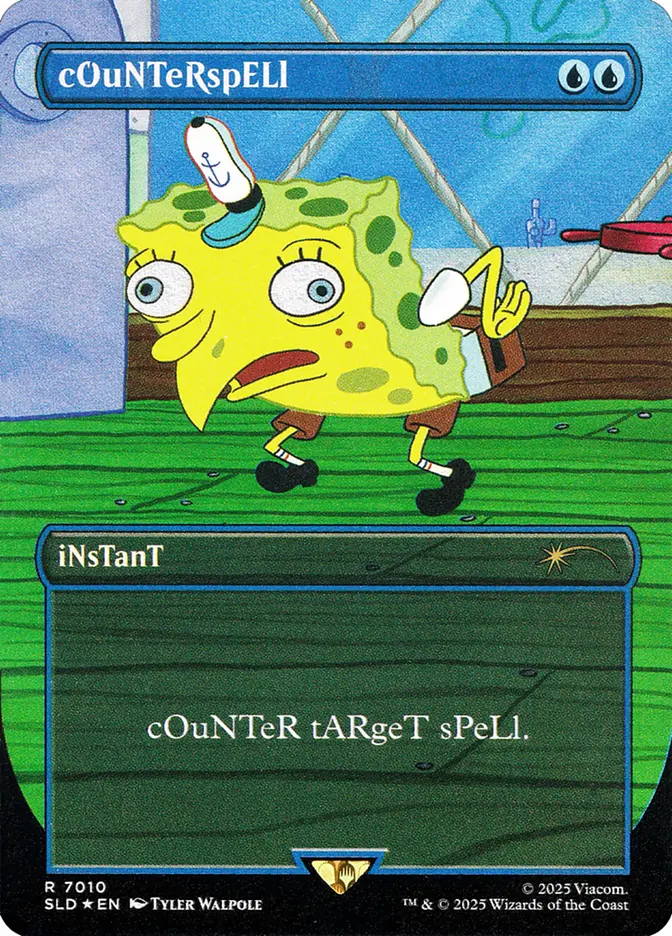


In terms of defensive options and counters, many decks opted to use similar spells. The most common counterspell was the namesake of counterspell itself. This was also paired with other more commonly seen powerful low mana curve spells like Arcane Denial, An Offer You Cannot Refuse, and the powerful Fierce Guardianship. The other more common defensive line-up were that of light stax pieces such as Propaganda and Ghostly Prison. Authority of Consuls showed up a few times as well. While many defensive options were often counters, there were also a number of blinking or avoiding spells/cards that would protect creatures or the player. However, almost all options shown were fairly popular cards used in many lists.


Behind counters and stax pieces, the other general options were that of the omnipresent Teferi’s Protection and Cyclonic Rift wherever they could be fit. Heroic Intervention was also an extremely prevalent choice as well. For the boots, the two that saw any mainstay play was that of Lightning Greaves and Swiftfoot Boots likely for their constant printings. Silent applause for my boy, Krenko, for bringing Blood Moon into his list. There were a mix of free spells as well such as Flawless Maneuver and Deflecting Swat in the mix. Furthermore, while not a mainstay, a chunk of decks’ protection were Grand Abolisher effects. Rhythm of the Wild was a very common option in any decks with Gruul colour pairings within them likely to deal with the plethora of counterspells running around in blue decks. Hats out to Edgar Markov for running a single protection spell with Teferi’s Protection and nothing else (according to my pre-made categories).


Removal appears initially more diverse than that of protection based options. The reason for this is because many decks opted to use on-theme removal, leading to an assortment and addition of creature based removal whereas defensive protection was mainly in that of spells. Of course, the generic go-to-cards such as that of Generous Gift, Chaos Warp, and Beast Within were prevalent. Still, there were many generic options that were for each colour such as Swords to Plowshares and Path to Exile in many white decks. Anguished Unmaking showed up several times with any Orzhov pairing. There were very few options for removal that targeted enchantments with most being creature-based removal, but that makes sense, considering the number of creature-focused decks, since, even among the top twenty-five, creature-focused decks far outnumber that of any spell-focused decks. I guess the trio of any permanent removal above would suffice for anything out of the ordinary, presuming you draw them. I also want to point out that removal was far less popular than protection with a difference median of four points between them.


Win-cons were not surprising by any measure. Tribal decks had their typical win-cons with that of spawning high mana drops of their tribe or in Lathril’s case, the classic elf-ball Craterhoof. What was surprising was how many decks lacked instant or direct win-cons. Win-cons, by the definition I created for the sake of organizing decks, is a very open category and also consists of any card that doesn’t fit other definitions but pushes for game with damage or accelerating towards a winning direction or plan. As expected, many decks used the art of combat to whittle down life bars before closing in on the kill. Of course, some decks also packed one or two sneaky wins like Edgar with his Sanguine Bond and Exquisite Blood in multiple ways (please, you’ve got the whole squad with Bloodthirsty Conqueror, Vito, etc.). Most decks focused primarily on combat buffs either with counters or the common Akroma’s Will. There were few alternative win-cons with only one deck trying Twenty-Toed Toad and Triskaidekaphile (Ms. Bumbleflower). Nekusar and Valgavoth hold the most “win-cons” by my definition with many of their cards looking to go for the throat or pushing damage at every opportunity. I’m not exactly sure how Y’shtola will ever ramp to go for a game ending Exsanguinate, but I guess if life totals get low enough, that spell will finish the job. Don’t think I forgot you, Giada, you and your sneaky The Book of Exalted Deeds.

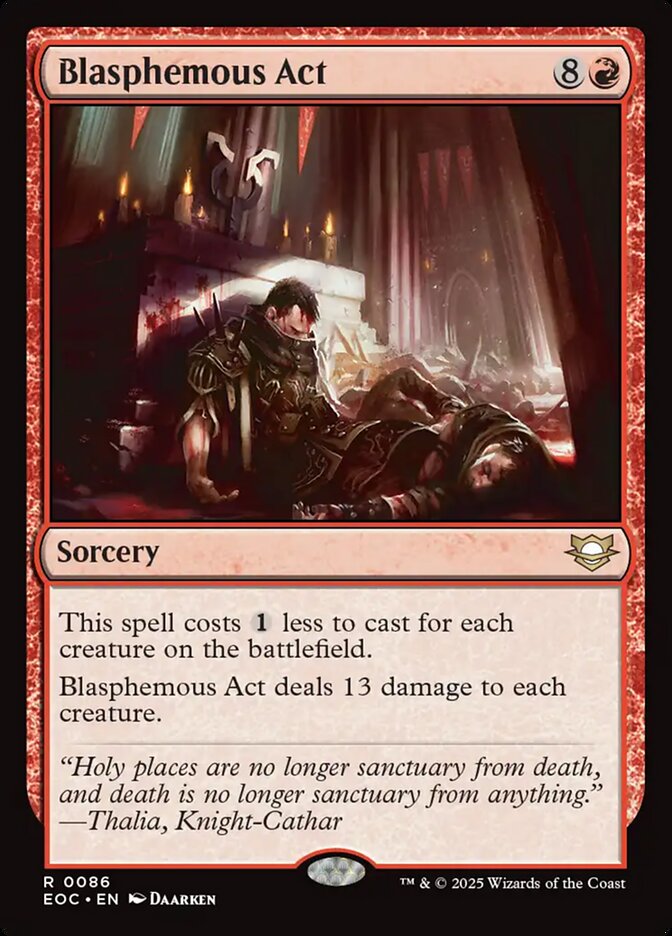
The least common category were wraths. Most decks slotted at least one form of a wrath with the most common wrath being Blasphemous Act. I presume the reason for this being that Blasphemous Act has been essentially reprinted every other set, and as such, it’s dollar price is cheap and the fact that it shows up in many pre-cons. The median was two. Valgavoth understands me with his five wraths. Yuriko, Teval, and Atraxa run no wraths at all, choosing to embrace the tide of death. Most notably, most wraths present only deal with creatures with the one or two oddity here and there. I know there are much cheaper wraths, especially in that particular colour combination, but Abzan decks really love their Ruinous Ultimatum.

Lastly, in terms of playstyle, the vast majority of decks function as midrange (according to my definitions and not including multiple functions). The least popular of which was poison and mill which were only represented by Atraxa and Nekusar respectively. Even punish was more popular with that of both Nekusar and Valgavoth. A large number of decks were also tribal in nature (technically another form of midrange). There were only three decks that I’d consider as true spellslinger decks. Combo was also at a low point with around four decks.
Miscellaneous:
As for some smaller notes that I’ve compiled while looking at lists:
- For a deck focused on non-creature spells, Y’shtola has quite a few creatures to note.
- Krenko runs a Thousand-Year Elixir for some reason, but my assumption is that this is solely and mainly for getting his own activation immediately twice (seems like an oddly specific tech). His deck does have a few creatures that need to tap for abilities, but it’s fairly rare.
- I am thematically disappointed that Krenko’s deck does not run Gamble.
- Kenrith outramps everyone at the table including Toph and the Ur-Dragon.
- Kefka’s average deck suggests eleven GCs as the sole outlier in that category.
- Cloud and Pantlaza were the only two decks not to run a single GC.
- Not many decks were running MDFCs in general with the singular exception of Sink into Stupor.
- I expected more lists to be running Black Market Connections, but the card is only in two decks with Y’shtola and Edgar Markov.
- Krenko tops any basic checks out of anyone at the table with 29 mountains.
- Conversely, the Ur-Dragon had the most unique land counts with 31 unique lands.
- Cloud is tied with Kaalia for the most tutors that are non-GC out of everyone.
- Vivi being in Kefka’s deck is kind of hilarious in a sort of ironic sense.
- I hate Sheoldred.
- The deck I dread facing the most in this list is Nekusar’s by far; the deck runs the most wheels and wants to ping and deck everyone out at any cost.
- Alternatively, the most chill one I see out of this list feels like it’s the Wise Mothman.
Conclusions:
Now, as I was looking at the data, something struck me and it made perfect sense when I considered the choices that were in the decks provided. The reality of many of these decks are that they are essentially just upgraded pre-cons. Many of the core cards within these decks, outside of a few exceptions, as long as they originated from a pre-con, remain within the decks themselves. The other key point to note is that many cards that were added in are often from the same block from which the commander originated from. There are many reasons for this, but the main assumptions I have are that there is convenience in adding in cards that came out around the same time as the pre-con in question, and furthermore, these cards often fit more thematically into the deck (e.g. dragons fit with dragons).

These suggested decks are not cheap. If one were to build the deck as suggested by the average aggregate on EDHRec (price-checked by TCGPlayer using their mass-entry option [auxiliary fees are included to make it easier to read data so take the price with some slight variations]), the cheapest was Ms. Bumbleflower at a whopping 325.08 USD up to 1552.09$ USD for Kenrith, the Returned King (Toph has an outlier price). The median price was around 781.86$ USD for a single deck. Much of this price may be related to the upgrades to the mana base along with inclusions of premium cards or exclusive cards that were only printed once such as pre-con exclusives. An example of a card that found its way into some decks but was entirely removable was that of Sheoldred, the Apocalypse. This is a powerful card for sure, but it doesn’t make or break a deck by any measure. Usually, many of these cards are expensive additions that either help the deck win harder or are flashy all-time favourites or “staples.” Players can also opt for cheaper spells that perform a similar function but with a higher cost attached such as replacing Swan Song with Strix Serenade. Granted that most threats on this list are creature based, that type of removal may be far more effective as well.
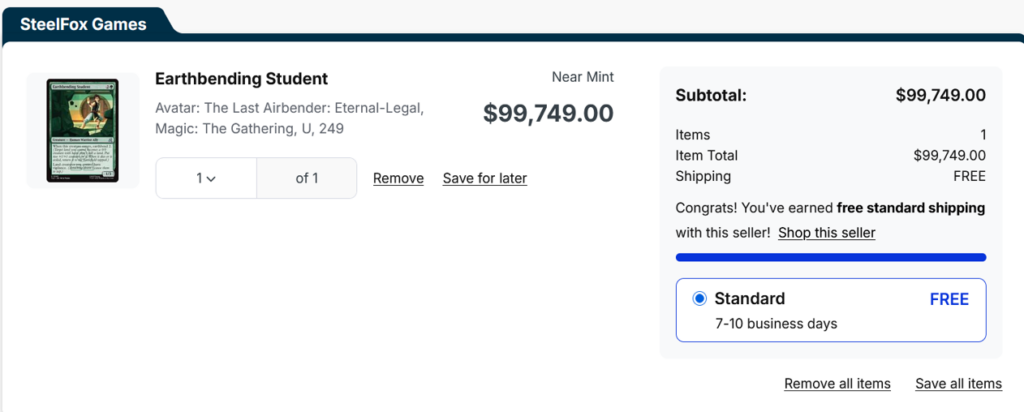
The presumption here is that many players opted to buy a pre-con and just stick with it, giving it upgrades as time passed by. However, given the average deck list, it would be a lie if I were to say that they tried to maintain a simplified nature with their deck lists. While the commanders themselves have not changed, these decks are indefinitely powered up either through powerful advantage engines, interaction pieces, or raw cards that are powerful on their own. Beyond the conversation of casual vs. competitive, players are seemingly attracted to power, and it’s reasonable considering power enables more flashy and interesting plays while adding consistency to make for a better experience overall. However, that may also lead to more congregated piles of similar stuff, a slop, in another sense which may affect the overall identity of the decks themselves.
Once again, thanks to EDHRec for providing this data. If there is interest, I may follow-up with an article that showcases the methodology and breakdown of how I assembled said data.