
In the past few months, I’ve been hearing this question being asked more and more, and I’ve wondered this myself. As such, I’ve decided to tackle the subject directly. Before we continue, we have to contextualize the question itself. “Samey” applies to a bunch of different aspects of the game, and we’ll try to break down some common questions associated with the sentiment.


Let’s tackle the first and foremost common association with the term, “samey”, which is designs have become essentially ubiquitous. As a way to start a conversation about this sentiment, I’ve shown three commanders that have been released in the last two years. These are just some samples, and there are many more, but I’ve chosen these in particular because it’s easier to directly see what I mean with this rising idea. Although each of these cards functions quite differently and has different game plans thematically, these face commanders made for Commander by Wizards all do one exact same thing. They represent card draw in the command zone. Many of Wizards’ recent designs in particular do still carry some amount of unique design space, but they’ve created and pushed for a common theme of advantage straight from the command zone.
I’m not saying that’s a bad thing. Honestly, it’s made it much easier to get into the game as a whole by reducing the immediate importance of assembling some engine for advantage. I’m not saying you shouldn’t prepare yourself with ways to get additional hand or mana consistently either; it’s just, with this advantage built into your command zone, it feels like you have a failsafe should you ever really need it. But I can get where the whole idea of modern card designs feeling like “do something, draw a card” as, honestly, if you look at the above, that’s pretty much all these cards summarized in a nutshell.


I’m also going to make a distinction here, and not to rile up folks with nostalgia, but it’s not like the older commanders that people can recall or took the spotlight for years are much different. They essentially do something quite similar with advantage generation to some extent. The more so problem is the general powercreep that is quite obvious. It’s no brainer that most modern commanders are cheaper and faster to employ than the ones from even half a decade ago. This is a conscious design, and while the players may be mixed on this, this has partially both helped and made the format faster and more convoluted.
I won’t go as far as to say that the entire landscape for Commander has warped. The game has fundamentally remained the same. The rules haven’t changed much at all if any from its time of origin. The games have just become faster and more efficient due to the cards being printed in modern design. You’re functionally doing the same thing as you did a decade ago just with less requirements, more available resources, and on earlier turns.


The next sentiment that comes to mind is that cards all feel the same because there’s so many exact clones of the same effects. This one, I’m just going to say is not true. As much as people complain about Wizards’ designs, it’s incredible that the vast majority of their cards are straight up unique. What people are complaining about is that many cards share similar effects. That is true. Look at the above as an example. Now, one thing to note about the soul sisters is that they’ve been around for a very long while. These cards are nothing new to Magic. In fact, there was even a competitive deck at one point built solely around these types of effects.
I don’t really think that this perception of deck designs being repetitive and using multiple copies of the same cards in their general effects is anything new or revolutionary. At its core, Magic is all about consistency and making sure you can get your game plan out. It makes sense to play multiple copies of an effect you would like in order to increase your chances of drawing and deploying said effect. This is even more so important in a game like Commander when your deck consists of ninety-nine cards.
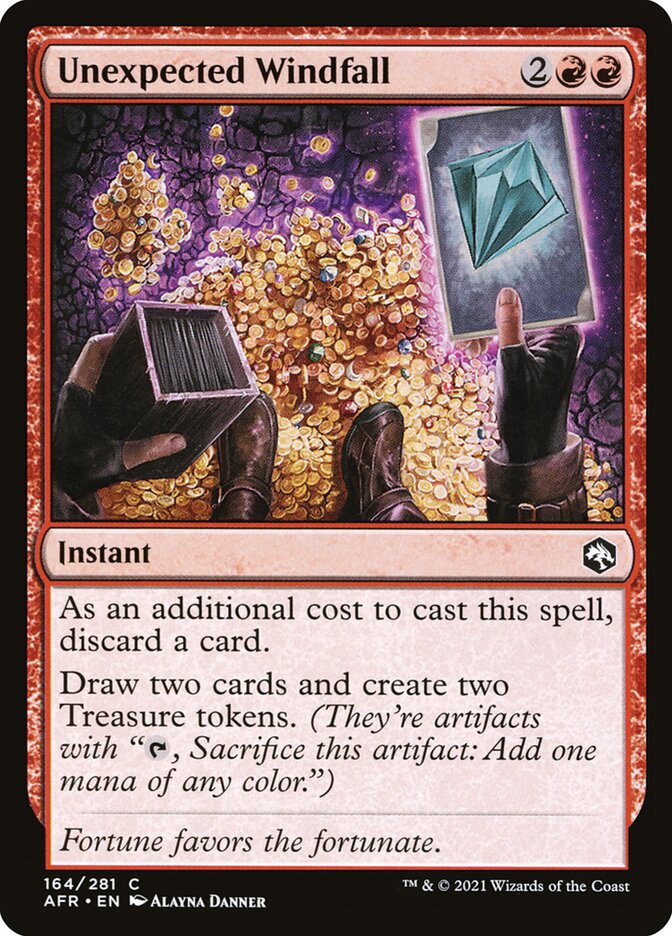
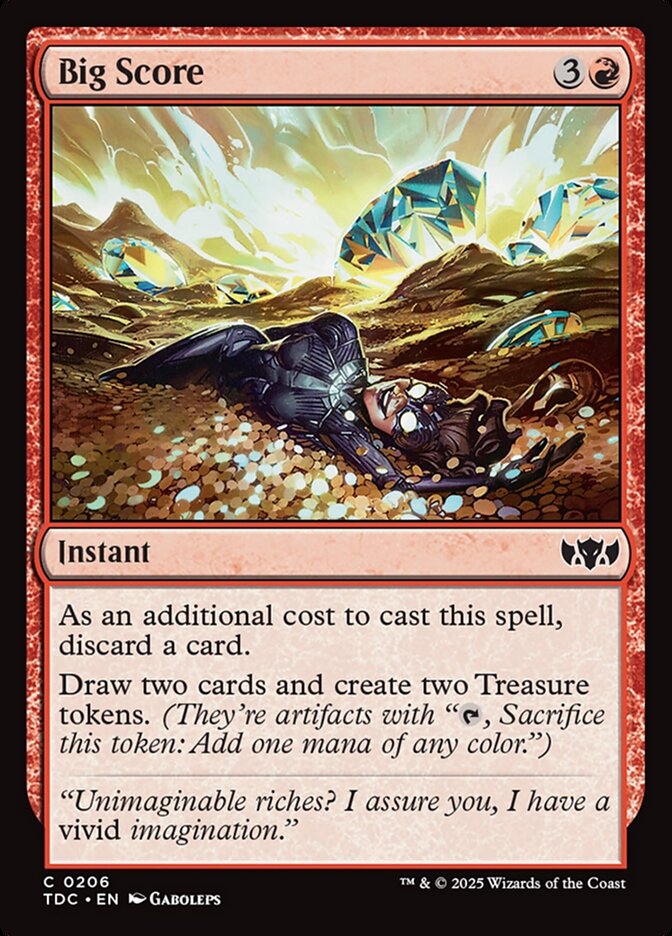
I don’t think that people are particularly annoyed at decks and designs that are relatively repetitive as long as they are low to the floor abilities that are either utility or provide little impact on the board state. For instance, you don’t see people really complain about either of the two above paired together in almost every deck they’re featured in, even though, outside of the easier casting requirements of Big Score, they’re functionally the exact same.


I think, when people refer to repetitive and “boring” sights, its the constant onslaught of well-known combos or highly impactful cards. Wizards has contributed to this as they’ve printed even more enablers of such effects. However, at their core, it’s not like these strategies haven’t existed in the past. It’s just, with newer cards, they’ve become far more efficient, obvious, and repetitive. Look at the well-known three card pairing above (the reason I call it a three card pairing is you need something to kickstart the drain). You have multiple versions of this on different bodies that are effectively substitutes for parts of the combo. Bloodthirsty Conqueror, Vito, Thorn of the Dusk Rose, Plague Drone… These are just some examples of these repetitive replacements. While the constant printing of the same effects effectively on newer cards is fair to blame on Wizards, it’s not their fault that players keep trying to emulate and multiply the same type of effects in their decks. Players are just drawn to these types of effects and they want to make them consistent in their decks; that’s entirely a community issue.


The third general consensus on ubiquity is that of “format staples.” I’ve been playing for almost a year now, but even when I mainly watched Magic in the past, it felt quite boring to see the same exact end game cards over and over. It became a running joke where, if you were playing green, you’d always have that pocket “hoof” in your back, the old reliable. Win conditions have been, not necessarily become, more generic. You could probably even guess how and what players could typically use to win just based on their board state, the commander’s text, and what they’ve been doing throughout the game. Have a bunch of little dorks? Triumph of the Hordes. In the case of Moonshaker Cavalry, this is just white Craterhoof in all honesty. Just because you run this card doesn’t make your strategy unique or new. You were looking to likely overwhelm your opponents with a thick wide board anyways; it’s just, it’s been simplified for you with the evasive “hoof” that gives your entire board flying.


The other problem is the generalization of gameplay in Commander. You’re in green? Turn two Rampant Growth. Turn three, Kodama’s Reach or Cultivate. Turn four, cast your commander. Personally, I’ve come to despise these ramp spells because I’ve become so bored of seeing them every game. Don’t let that stop you from running them if you enjoy it. It’s not entirely a sin to be ramping and trying to setup your board in the early game. That’s pretty much a quintessential part of Magic’s gameplay. My problem is when the early game cards look all the same, especially in a format with access to much of the game’s available tools throughout its 30+ years of game design. I would prefer playing more on theme style cards that accomplish the same thing as the above cards just for some extra spice. And if it’s casual commander, you don’t always have to efficient and perfect in your mana curve. Do what is fun. Have big butts? Entish Restoration. Need to sacrifice bodies for effects? Wight of the Reliquary. What I will commend Wizards for is the plethora of multiple options that can fit certain niches of decks.
I will only accept Steve because I like Steve. Steve blocks, Steve chumps, Steve spawns any basic that I need. Steve is love; Steve is life. It’s commander; sometimes you have your “pet” cards.


Don’t just hate the green players though you should. It’s not like any other colours aren’t attempting or doing the same thing. You don’t have access to ramp spells, but you can just drop the rock squad. Signets, talismans, Fellwar Stone, you name it. You’re effectively doing the same thing just with a different version of the effect.
Furthermore, I find this is where the real generalization is very much shown. I can get using these to spawn out your commander early, but what I don’t get is when players don’t tailor their rocks, especially the higher costed ones to their decks. Are you god-themed? Altar of the Pantheon. Multicoloured and care about life? Ancient Cornucopia. Sacrifice and broken graveyard recursion synergies? Ashnod’s Altar or Phyrexian Altar.
You probably rolled your eyes at the last crossed-out suggestion. And it’s because you’ve probably seen the infinite combos that those cards accomplish. Play a Blood Artist, drop an altar, have a card that recurs itself, drain the table infinitely. I’m not saying that you’re wrong for doing that. It’s how you chose to play. But, that won’t stop others from nodding off as they see just another “innovative” Blood Artist combo #3215.
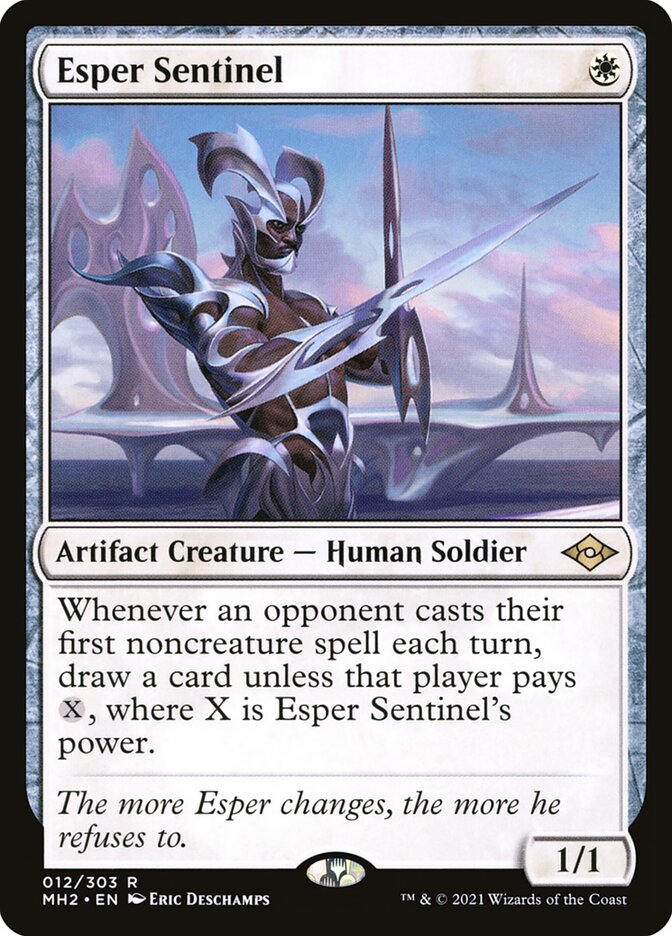
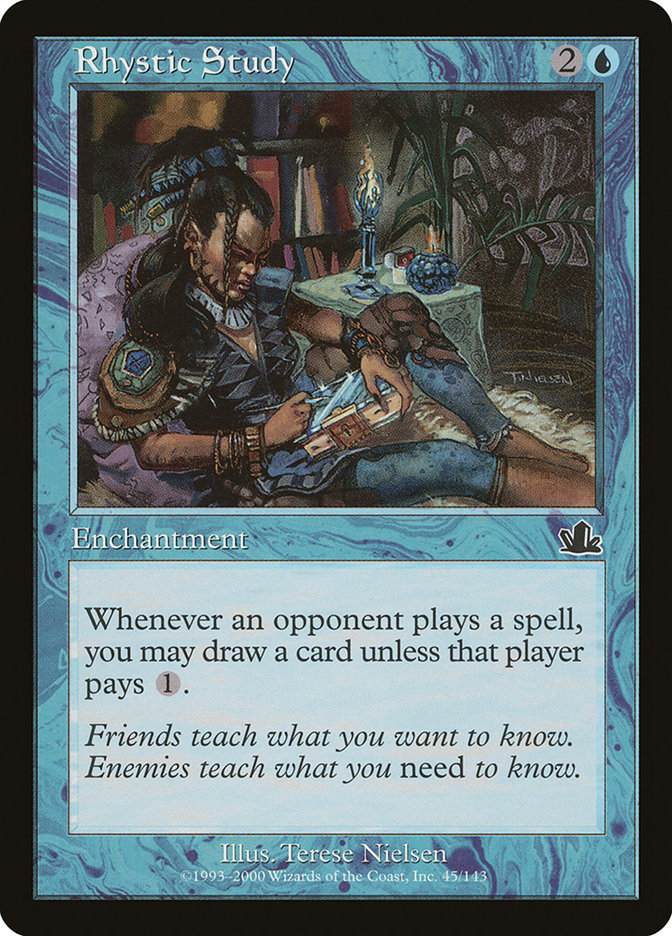
A few people blame the cEDH crowd for homogenizing cards since many of their advantage engines and interactions are very similar. But, in their defence, they’re not playing casual Commander. I’m not going to get into the debate here trying to talk if we should separate the two, but the intent is very different. cEDH is all about efficiency and best-in-slot since they are looking to win as fast as possible. As such, it make sense that they are drawn to very powerful cards that they’ll all almost be equally running anyways.
The last part I want to draw attention to is the constant uniform resource site known as EDHRec. Whether you are starting off in Commander or are a long term veteran, it’s more than likely you’ve visited the site at some point in your gaming journey. I’m not here to say that EDHRec is bad or evil. EDHRec is exactly as it explains itself to be. It is a resource site. It does not build decks for you. EDHRec just gathers data and showcases cards and which cards players generally associate with those said cards. It shares some synergies that people consider, but this is completely just based off of numbers. I need to repeat that EDHRec does not build decks, at least for its primary use. You should be using it for EDH recommendations (the rec part of its name).
I find the most organic way to learn about the game and build your deck while tailoring it to yourself, and if you seek that unique design experience is to look at the cards directly. I highly recommend you go on Scryfall and look up cards yourself. Learn how to use the tags to better find synergies that you want. I also want to state that there’s no real thing as “expected amounts of x function” in your deck. Decks are tailored towards your needs, your pods, and your thought processes. If I could, I would always play 99 draw and ramp if given the opportunity since I like playing cards and being able to play them.
Furthermore, there’s plenty of content creators out there to both teach you the game, provide deck assistance, and help with evaluating cards for all kinds of experiences.
Here are list of the ones I watch myself with links to their channels:
- Tolarian Community College (TCC)
- Maldhound (professional “monogreen” enjoyer)
- Salubrious Snail
- The Trinket Mage
- 3/3 Elk
Also a shoutout to channels about Magic as a whole if you want to learn more about Magic:
These are just the ones I subscribe to the most and recall. And there’s so many more. Don’t skip out on small or emerging channels or content creators as well (like myself). Finally, you don’t have to agree with anyone on any certain opinion. Content creators may make mistakes or have ideas you don’t quite flow with, and it’s okay to just not agree and do your own thing. That also relates to others who play the game. You don’t have to accept 100% of what anyone says, and it’s okay to disagree or take a partial opinion. But I will also say this, if you do plan to play powerful generic cards, you should be prepared to take the heat. You may enjoy and push that design, but that doesn’t mean the other three players at your table will necessarily allow you that experience.